Battle of Berlin
Los pacientes del doctor GarcíaThe Battle of Berlin is the last and most consequential ordeal in Adrián Gallardo Ortega’s wartime story: amid the city’s collapse, he abandons his own identity, surrenders under Alfonso Navarro López’s papers, and leaves behind a body whose absence will complicate the search for him. The novel presents the battle not as a single heroic tableau but as a drawn-out experience of bombardment, hunger, exhaustion, and compromised loyalties. Its ending converts battlefield survival into a postwar mystery: Adrián is reported as a defender of Berlin, yet the person who emerges with Navarro’s documents cannot safely claim his own name.
The City’s Last Defensive Ring
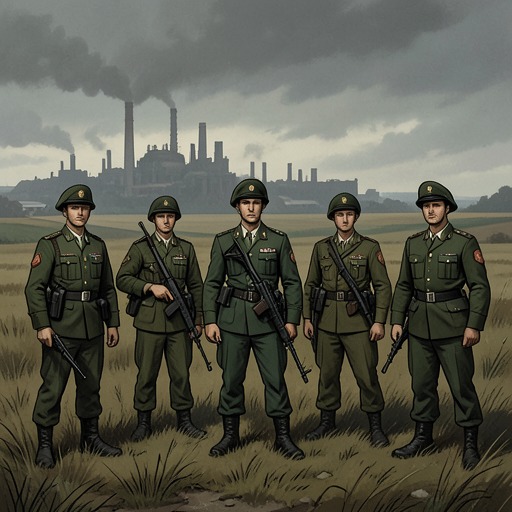
The final phase of the fighting closes around a small group of defenders stationed in a damaged palace on Unter den Linden. They spend a week clearing rubble from the building so they can occupy it, even as its fragile walls seem likely to collapse in another air raid. Their commanders dismiss the prospect of a further bombardment. The expectation that Soviet ground forces will soon overrun the city makes an air attack seem wasteful, but the defenders’ assumptions prove wrong: on 10 April, more than twelve hundred Soviet aircraft strike the remaining Nazi stronghold in a mass raid that makes the already devastated city look newly ruined.
Before the Soviet infantry reaches the city’s final defensive ring, the soldiers’ routine is defined by waiting. Food is scarce, and their officers permit them to spend much of the time sitting inside or among rubble in the garden. To prevent desertion, the men are confined to their compound, where idleness becomes almost as oppressive as the approaching enemy. Adrián and Jan Schmitt pass the time together, set apart from the desperate fighting in Berlin’s outer districts. On 24 April, the familiar warning that the Soviets are here finally proves true: beyond the last ring, there is only Berlin, and within Berlin, only the defenders.
A colonel addresses the men from a table, urging them to defend the city street by street and house by house, and presenting their deaths as a sacrifice that future generations will honor. The scene exposes the gap between the language of heroic resistance and the condition of the soldiers expected to enact it. Adrián, twenty-eight but feeling old, registers the tears of the colonel and his companions without sharing their fervor. Klooga has left him unable to feel much beyond physical sensations such as hunger, thirst, heat, and cold. He understands the solemnity of the speech but sees its glory and honor as theatrical decoration over a dirty, certain defeat. He expects to die in a foreign land for a cause that is not his, and believes that surrender will not spare him from eventually paying for what happened in Estonia.
Bombardment, Hunger, and Defeat
The destruction of the palace turns the men’s precarious shelter into a death trap. During the 10 April raid, Adrián is wounded and suffers a broken bone. At an improvised aid post beside hospital ruins, a doctor sets the bone, treats the wound, and places his arm in a sling. Jan’s companion Lazlo returns with two aspirins requisitioned at gunpoint; the doctor advises Adrián to take one and save the other. The incident is small beside the scale of the bombing, but it captures the shrinking terms of survival: medical care, a little bread, and whatever can be taken from the ruins.
The men have eaten no more than pieces of bread scavenged from a bakery being looted by a crowd. Their comrades have gone hungry, too, and the bombs have buried the palace kitchen. No one remembers the survivors until the following morning, when they are distributed among other barracks in buildings just as ruined. Inactivity, hunger, and boredom begin again. The military collapse is thus experienced less as a clean sequence of advances and retreats than as a cycle of confinement, inadequate food, damaged shelters, and orders delivered to men who have little control over what comes next.
On 1 May, the defenders prolong their resistance for another twenty-four hours, preventing the Soviet celebration of the holiday with Berlin’s capture. The next day, a Soviet tank points its cannon directly at Adrián’s position in a shell crater on Wilhelmstrasse. He emerges with his arms raised, but he does not surrender alone: he carries the identity papers of Alfonso Navarro López and leaves Navarro’s corpse undisclosed to the occupying soldiers. The act turns the military defeat into a personal deception. Adrián survives the immediate danger by letting the documents speak in place of his own identity.
Adrián, Jan, and the Identity Exchange
Adrián’s change of identity is inseparable from his relationship with Jan and Agneta Müller. In the final days, he is also dealing with the possibility that Jan and Agneta’s attachment has made him an outsider. He understands that Navarro had misread Agneta: she did not choose Jan because of his race, skin, or surname, but because of the love Adrián lacked. Yet the recognition does not undo the emotional force of the rivalry or explain away the violence that follows. When Adrián shoots Navarro, the act is not presented as a calculated punishment for being wrong, nor simply as revenge for the fear and jealousy Navarro represented. At that instant, Adrián is consumed by a love that leaves no room for any other feeling.
He tells himself he must cease to be Adrián if he is to have any chance with Agneta after the war. The victory of the Allies will reduce the old slogans and fervor to ashes, but that prospect does not immediately release him from what he has done. He no longer wants to die before he has kissed Agneta or experienced the intimacy he has imagined with her; at the same time, he believes his presence at Klooga will sooner or later exact a price. Others, including Kleiber and the men who served under him, can also be identified with the crimes there. The papers offer Adrián a way to evade recognition, not a way to erase responsibility.
The exchange also alters the meaning of surrender. Adrián raises his arms when the Soviet tank confronts him, but he conceals the dead man whose name he has taken. His survival depends on the discrepancy between the person the occupiers see and the person who has emerged from the crater. The novel makes this a decisive reversal: a fighter who had accepted death as the end of his obligation now has a reason to live, but the life he seeks is possible only through another man’s identity and a concealed death.
Aftermath and the Missing Man
After the war, the identity exchange makes it difficult to establish what happened to Adrián. A report associated with Kleiber’s case describes the extermination of more than two thousand Jewish prisoners in an Estonian camp and the murder of a German soldier who refused to obey orders. Kleiber maintains that his subordinates volunteered, including the man he executed for insubordination, and offers to identify them. The first person implicated is a Spanish professional boxer who went to the Russian front and was often seen with Jan Schmitt, a man with a Flemish first name and German surname who was born in South America. In the attached list, Jan’s name carries a question mark; the final entry is a Spanish-sounding first name, Adrian, also marked as uncertain.
The postwar search cannot turn that uncertain listing into a confirmed fate. Meg begins checking the lists held by the Allied Control Council in Spain, but Adrián is not recorded as wounded, a fugitive, a prisoner, or an officially registered missing person. The last known fact is that he took part in Berlin’s defense. He seems to have vanished. The records’ silence is not proof that he died; it is the consequence of a life lived under a borrowed name, with no body or document that reliably joins the battlefield survivor to Adrián Gallardo Ortega.
The uncertainty persists because the people around the assumed identity have their own reasons to keep moving between names and places. Agneta hides Jan in a storeroom when she returns to her family on 30 April. After the German capitulation, her father agrees to help, on the understanding that Jan is an ordinary soldier without criminal responsibility; Agneta can truthfully say that she knows nothing about Klooga. Jan enters the household and works at repairs, while concealing the number of his Argentine passport from prospective employers. The household’s sheltering of him and his continuing connection to clandestine associations show how the defeat of the regime does not simply end the political world that shaped the battle.
Years later, Adrián’s presumed story reaches Spain through a protector who believes he has returned. Don Antonio Ochoa welcomes him as a hero who defended Berlin to the end and says the Allies are searching for him. He has heard that the man intends to go to Buenos Aires, based on information linked to Jan and Messerschmidt. But this account belongs to the person using Adrián’s identity. The real Adrián realizes that someone has used his name to emigrate to Argentina while he was living in Schöneberg under another man’s identity. He says nothing, recognizing that for the moment he can use two identities as if he were playing with two decks of cards.
A Battle That Continues After Surrender
Berlin’s fall therefore produces no clean return from war. In the novel, military defeat opens onto a longer struggle over names, culpability, and protection. Adrián’s papers give him a chance to survive the Soviet occupation, but they also make the postwar record unreliable and allow another person to occupy the life attached to his name. The missing body of Alfonso Navarro and the unverified listing of Adrian are joined by the later confusion in which a supposed Adrián is welcomed as a returning hero.
The battle’s emotional center is the contrast between public narratives of sacrifice and the compromised private acts that follow. The colonel promises future glory; Adrián hears a performance masking an ugly end. He surrenders rather than dying under the prescribed slogan, but his survival requires concealment, and it does not settle the debt he associates with Klooga. The final image of Berlin is thus not only the tank on Wilhelmstrasse or the raised hands of a defeated soldier. It is the uncertain record left behind when one man lives under another’s name, allowing the war’s violence and its consequences to persist in the postwar world.